Serving Anaheim, CA and surrounding areas.(657) 220-6196
Katella Anaheim Concrete

Concrete Cutting in Anaheim, CA, Scanned for Pipe and Tendon Before the Blade Goes In

Katella Anaheim Concrete cuts trenches, openings and panels out of Anaheim slabs after a scan shows what is inside, copper or tension steel. Every estimate is measured and written on site.

Google reviewsFacebook reviewsBetter Business Bureau reviews5.0 Stars Rated by Anaheim customers · Google, Facebook and the BBB
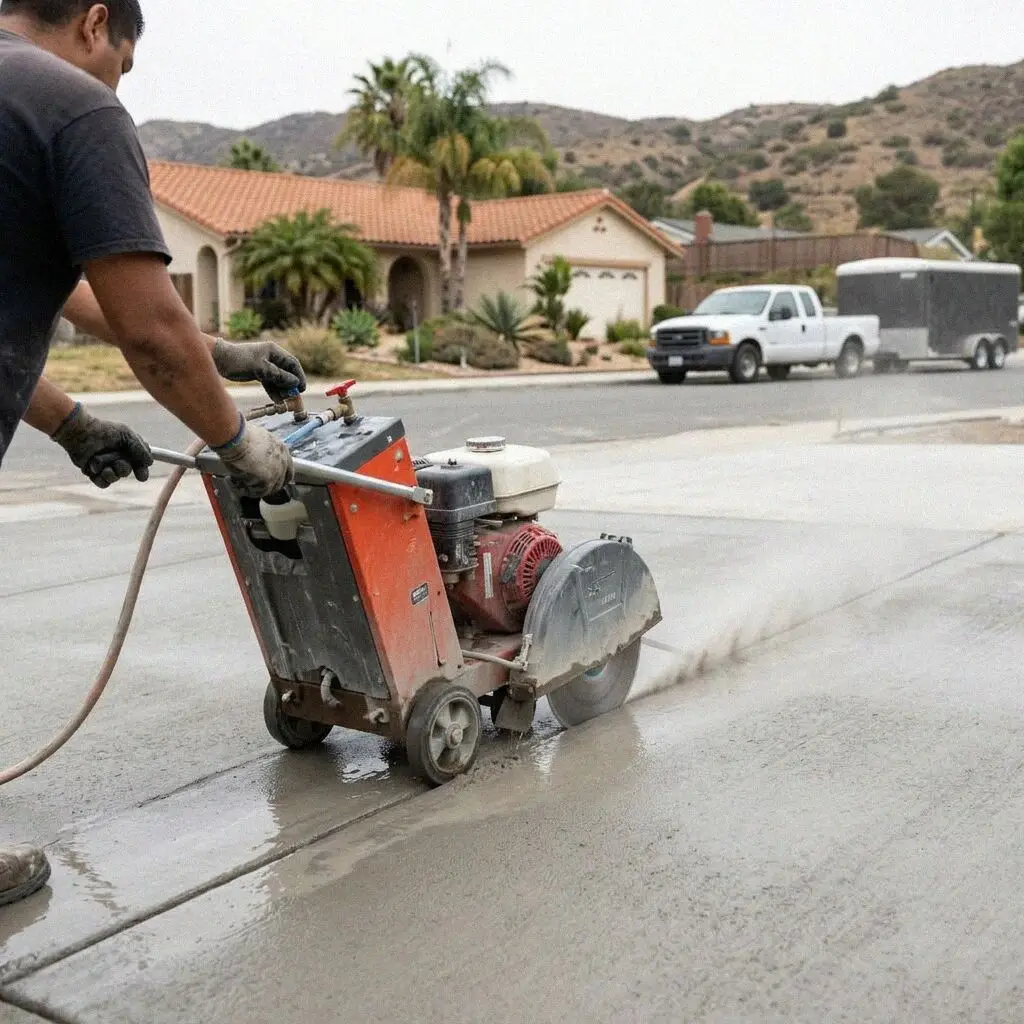
Walk-behind saw cutting a straight line across a garage slab in Anaheim, CA
Hands guiding a wet diamond saw along a chalk line on an Anaheim slab

The cut, explained

Cutting Concrete on an Anaheim Property

Concrete cutting is the controlled removal of one piece of a slab or a wall so the rest stays sound. A diamond blade run wet along a marked line takes out a trench for a pipe, a panel that has sunk, or a door opening in a block wall, with a square edge the patch can be doweled to. The alternative is a breaker, which takes out what it hits and cracks what it does not, and on a floor the house is living on that is the difference between a trench and a rebuild.

Katella Anaheim Concrete has cut Anaheim concrete since 2016 under Omar Espinoza, who ran saws and breakers on other crews for 22 years before opening here, and he marks every line himself. What sits inside a slab here depends on its age. The 1950s tracts on the flats carry their supply in copper set into the slab and their drains in cast iron just below it. The hill tracts from the 1980s on were often poured post-tensioned, with steel cables that must never be cut.

The work is done under a CSLB C-8 concrete license, with liability insurance on every job. Before a blade touches a slab with ground under it a DigAlert ticket is opened, since Anaheim runs its own electric and water, and the slab is scanned for steel, tendons and pipe. Every cut is wet, the slurry is vacuumed rather than run to the gutter, and the cut carries a written workmanship guarantee against defects in how it was built.


When a saw is the answer

When does a slab in Anaheim need to be sawn open?

A room that needs a drain

A garage becoming a bedroom, or a bathroom going where none was, needs a waste line that falls to the sewer, and on a slab house the only way to lay it is a trench sawn through the floor. Marking that trench to miss the lines already in the slab is the whole job.

One panel out of line with the rest

A driveway panel sitting half an inch below its neighbors has lost the ground under it, and on a hill pad that is usually the fill edge. Sawing the panel out on its joints and repouring it on compacted base keeps the rest of the drive, which a breaker would not.

A warm patch on the floor

A spot on the tile that is warm underfoot when nothing has been running is the hot supply line leaking inside the slab. It costs water every hour, and the fix is a trench cut to the pipe or a new line run above the slab, both of which start with knowing exactly where the copper goes.

Water running with every tap off

A meter that turns with the house shut down is a line open under the floor, and on river sand the water is carrying the ground away as it goes. That is a cut to be made this week, not next month, because every day the void under the slab grows and the floor above it starts to drop.

In every cut

What Goes Into an Anaheim Concrete Cut

Eight things are in every cut at no separate line, and each answers something an Anaheim slab does: hides copper and cast iron at the depth a blade reaches, carries tension cables on the hill, and drains to a gutter that runs to the Santa Ana River.

Lines marked at the visit

The cut is chalked on the slab with you standing there, so the trench or the opening is agreed to the inch before anything is written.

Scanned and located first

The slab is scanned for rebar, tendons and pipe, and a DigAlert ticket marks the city's electric and water outside, before a blade is chosen.

Corners cored first

Each corner is cored before the saw reaches it, so the cut stops on the line instead of running past it into the slab that stays.

Every cut made wet

Water is fed to the blade the whole way, which keeps the silica out of the air and the blade from glazing in a hard mix.

Slurry vacuumed up

The gray water is pulled up behind the saw and hauled off, never hosed to the street, because every gutter here drains to the river.

Pieces lifted, not dropped

Sawn sections are cut small enough to lift and carried out, so the sand under the next panel is not shaken loose by a slab crashing down.

Edges doweled for patch

Holes are drilled into the cut face and steel dowels epoxied in, so the patch poured later is tied to the slab and cannot drop below it.

Walk-through and guarantee

You see the cut against the chalk line, the depth and the dowels are on the sheet, and the written guarantee is handed over before we go.

The right saw

Ways to Cut Concrete in Anaheim, Compared

Four tools, set against what each is for, how deep it goes in one pass, how the dust and water are handled and what edge it leaves. The scan, the locate and the slurry vacuum are the same whichever is used, so the table is about the cut itself.

OptionUsed forDepth per passDust and waterLeaves behind
Walk-behind flat sawTrenches and panels in a floor or driveUp to 12 inches on a 30-inch bladeWet, slurry vacuumed behind the sawA straight edge to dowel a patch to
Hand saw and ring sawCorners, stem walls and tight rooms5 inches, or 10 with a ring sawWet, fed from a pressurized bottleA square corner with no overcut
Wet core drillRound holes for drains, vents and postsAny depth, 1 to 14 inches acrossWet, water caught in a collar ringA clean bore with nothing cracked
Track-mounted wall sawDoor and window openings in wallsUp to 20 inches on a 48-inch bladeWet, on a hydraulic headAn opening cut true on both faces

The flat saw does the most concrete an hour and the ring saw the least; the core drill is the one to use whenever the hole can be round, since a bore starts no crack.

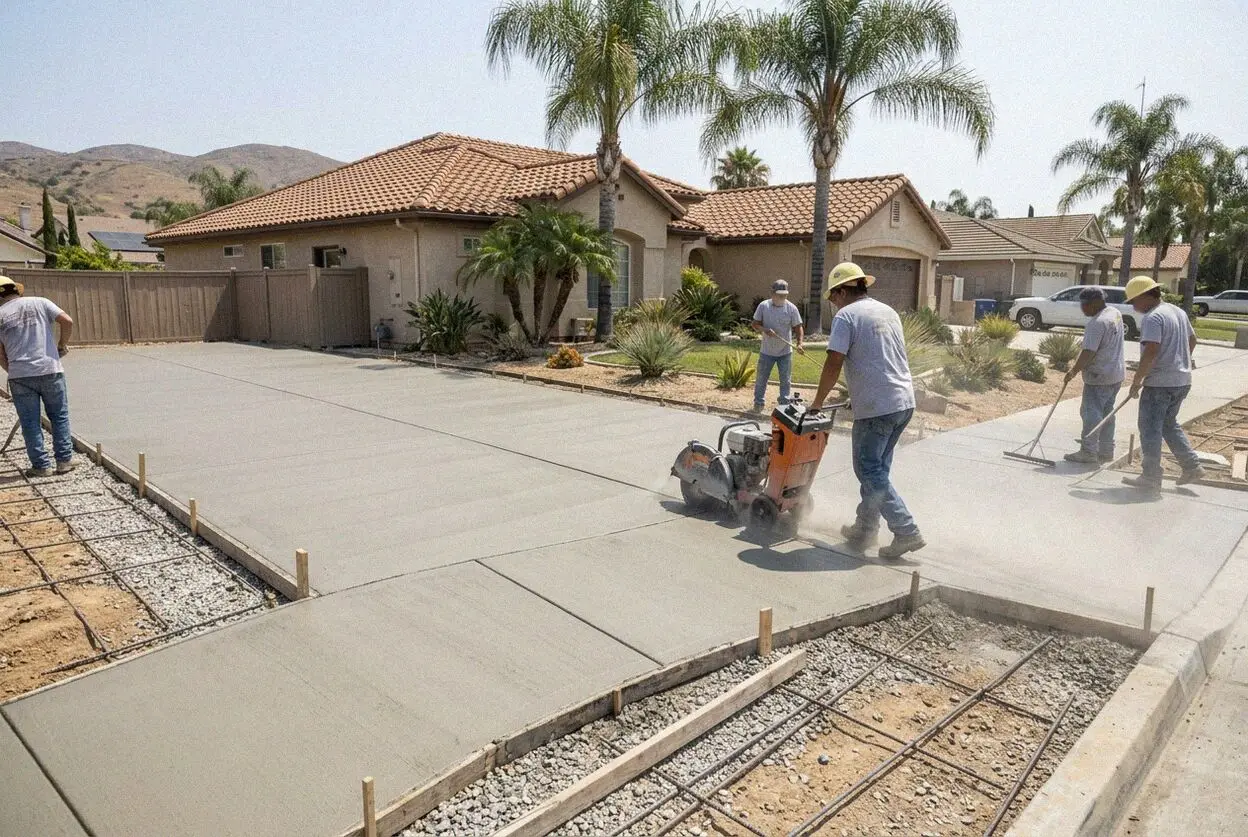
Crew cutting a slab wet with a walk-behind saw at an Anaheim, CA home

What is in the slab

Why Anaheim Slabs Are Scanned Before They Are Cut

What lies inside an Anaheim slab depends on when it was poured: copper and cast iron in the 1950s floors on the flats, steel cables under tension on the hill, and city lines under the drive.

The tracts west of Euclid Street and along Ball Road and Lincoln Avenue were poured in the 1950s with the plumbing in the concrete. The copper supply lines run through the slab itself, the cast-iron drains sit in the sand just under it, and neither is on any drawing you can get hold of now. A trench cut blind at 4 inches finds one or the other. So the floor is scanned, the run of the copper is drawn on the tile in marker, and the trench is laid out beside it rather than across it.

The hill tracts are the other case. Many slabs poured above Santa Ana Canyon Road from the 1980s on are post-tensioned, with steel cables stressed through the concrete and a warning stamped by the garage door saying so. Cutting one releases a cable at several tons of pull, so the scan comes first there every time and the trench is laid out between the cables it shows. A garage floor cut for a drain is repoured by us.

Visit to walk-through

How a Slab Is Cut on an Anaheim Lot

Five stages, with the same crew marking, scanning and cutting, and Omar Espinoza on the saw. The locate ticket is open two working days before the blade goes in, as the state requires, and nothing is cut before the scan.

1

Lines chalked, slab scanned

Omar Espinoza chalks the cut with you, scans the slab for steel, tendons and pipe, measures the depth, and writes the figure at the property.

2

Saw chosen, ticket opened

The saw is picked for the depth and the room, you take a date, and the DigAlert ticket is opened so the city's lines are marked before that day.

3

Water off, corners cored

Supply lines through the slab are shut, the room is sheeted off from the house, and each corner is cored so the cut cannot run past its line.

4

Cut wet, pieces lifted out

The blade runs wet along the chalk, the slurry is vacuumed behind it, and the sawn sections are broken small and carried out, not dropped through.

5

Edges doweled, handed over

Dowels are epoxied into the cut faces for the patch, the trench is handed to the plumber or closed by us, and you see the cut against the chalk.

Behind the estimate

What Sets the Estimate on an Anaheim Concrete Cut

The depth of the slab and the length of the line set most of the figure, and what the scan finds in the way sets the rest. Two trenches the same length can be a day apart once one crosses a tendon. Every estimate is measured and written on site.

A single-family slab house

The length of the trench and whether it is 4 inches of plain 1950s slab or 6 inches on rebar decide the hours on the saw and the blade it uses.

An apartment block on the flats

Cutting in an occupied building means the water is off to more than one unit, the work is sheeted from the corridor, and each day is scheduled.

A warehouse floor in the Canyon

Industrial slabs run 6 to 8 inches on a rebar mat, so a dock opening or a machine trench is a bigger blade, more water and slower going per foot.

A post-tensioned or finished slab

A hill tract slab on tendons is laid out between the cables from the scan, and a stamped or polished surface is cut so the patch can be matched.

The visit, the scan and the written figure cost nothing, and the call to book them comes within 1 business day. (657) 220-6196 or send us a message.

Want your Anaheim slab scanned and marked?

Send the form or call and you hear back within 1 business day with a time. Omar Espinoza chalks the line with you, scans what is under it and writes the figure at the property, with the depth and the saw on it. You decide from there.

Request a Free Estimate

Written on site · No obligation

By submitting, you agree to our disclosure and consent terms, including being contacted by Katella Anaheim Concrete.

Cuts we made

Three Anaheim Concrete Cuts, in Their Owners' Words

Three reviews from Google, Facebook and the BBB, each about a cut rather than a pour, and each naming the length of the trench or the size of the opening that was sawn.

Google review

“Our slab in Anaheim Hills has the post-tension warning stamped by the garage door, and two other outfits would not touch it. They scanned the floor, drew the cables on the tile and cut a 14-foot trench for the new bathroom drain between them. No dust in the house and the edge was straight.”

Dana K. of Anaheim HillsDrain trench in a tensioned slab · Google · 2025
Facebook review

“The kitchen floor in our 1955 house in West Anaheim was warm in one spot and the meter kept turning. They found the copper with the scanner, cut a trench 18 inches wide alongside it and had the plumber in the same afternoon. The slurry went into their tank, not down my driveway.”

Victor P. of West AnaheimSlab leak trench and patch · Facebook · 2023
BBB review

“We needed a second roll-up door in a tilt-up unit off La Palma Avenue and a trench across an 8-inch floor for a machine drain. The wall saw cut the opening in a day, the floor took another, and the edges were doweled ready for the patch. Next door never heard it over the forklifts.”

Raj S. of Anaheim CanyonDock opening and floor trench · BBB · 2021

Before you book

Concrete Cutting Questions Asked in Anaheim

What moves the figure on a cut, how long the floor is open, which permit the work behind the cut needs, what a policy pays for and what is guaranteed, answered for a slab on either side of the city.

(657) 220-6196
  • What moves the figure on a slab cut in Anaheim?

    The depth of the slab, the length of the line and what the scan finds in the way. A 4-inch 1950s floor cuts at walking pace, a 6-inch drive on rebar takes a bigger blade and more water, and a warehouse floor at 8 inches is slower still per foot. A trench that has to be laid out between tendons, or moved to miss a copper run, takes a redraw before it takes a saw. All three are measured and written at the property.

  • How long is the floor open during a trench cut?

    A day to cut and lift a trench of 20 feet or so through a house slab, and the floor then stays open for as long as the plumber needs, usually a day or two, before we come back to dowel and patch it. A door opening in a block or poured wall is a day on the wall saw. A driveway panel is cut and out in a morning and repoured the next day. None of it is shortened by cutting dry, which is why every cut here is wet.

  • Is patching the floor part of the cutting estimate?

    It is written as its own line, so you can see it and choose it. Some owners want the trench handed to their plumber and the patch done later, and some want us to dowel, backfill, compact and pour the patch as soon as the pipe is inspected, and the estimate carries both so the figure does not change on the day. Always in the cutting line are the scan, the locate, the water, the vacuum and the dowels.

  • Does cutting a slab in Anaheim need a permit?

    The cut does not, but the work behind it usually does. A new drain or a re-piped supply line takes a plumbing permit from the city's Building Division and the pipe is inspected in the open trench before the patch goes over it. An opening in a bearing wall or a tilt-up panel takes a building permit on an engineer's drawing. We open the trench when the inspection is booked, so the floor is not left open on paper.

  • Does insurance pay to cut a floor for a slab leak?

    Often for the cut, rarely for the pipe. Most California homeowner policies exclude the leaking line itself as wear but pay to tear out and replace the part of the building that has to be opened to reach it, and a trench through a slab is exactly that. What they do not pay for is a leak that has run for months and shows on an old bill. Photograph the meter and the wet spot and ring your carrier before the cut.

  • What is guaranteed on a cut and its closure?

    That the cut is where the chalk line was, to the depth on the sheet, with no crack run into the slab that stays, and that a patch we pour is doweled to the old edge and sits flush with it. That is a written workmanship guarantee against defects in how it was built. It does not cover the pipe in the trench, which is the plumber's, or a stamped patch matching the old shade. Where the cut is at fault we fix it.

  • What saws and blades cut an Anaheim slab?

    Diamond blades with laser-welded segments, run wet on a walk-behind flat saw for floors and drives, a 14-inch hand saw or a ring saw for corners and walls, a core drill for round holes and a track-mounted wall saw for openings. The scanner is a ground-penetrating radar unit that shows rebar, tendons and pipe as a line on its screen. The saw and the blade for your cut are named on the estimate, with the depth.

  • Can we stay in the house while the floor is cut?

    Yes. The room being cut is sheeted off from the rest of the house, the saw runs wet so there is no dust past the sheeting, and the noise lasts the hours of the cut itself. What is asked is that the water can be shut off for those hours, that the room is cleared of furniture, and that someone is home for the chalk line and the walk-through. A cut in a garage or a drive asks only that the cars are out.

Towns we cut in

Concrete Cutting Around Anaheim, CA

The eight nearest towns on the coverage list, with the straight-line distance from the office on West Katella Avenue beside each. Every cut is chalked and scanned at the property before a figure is written.

Show All Areas We Serve

Book a free scan and chalk line on your Anaheim slab

Call or send the form and you hear back within 1 business day. Say what the cut is for and roughly when the slab was poured, and the visit can be booked for a day inside the same week.